

Heraldry · Languedoc · 1669
The D'Olive Coat of Arms
A shield of gules bearing three bands of gold — the sovereign mark of a French magistrate family whose arms were confirmed by royal judgment in 1669 and 1670.
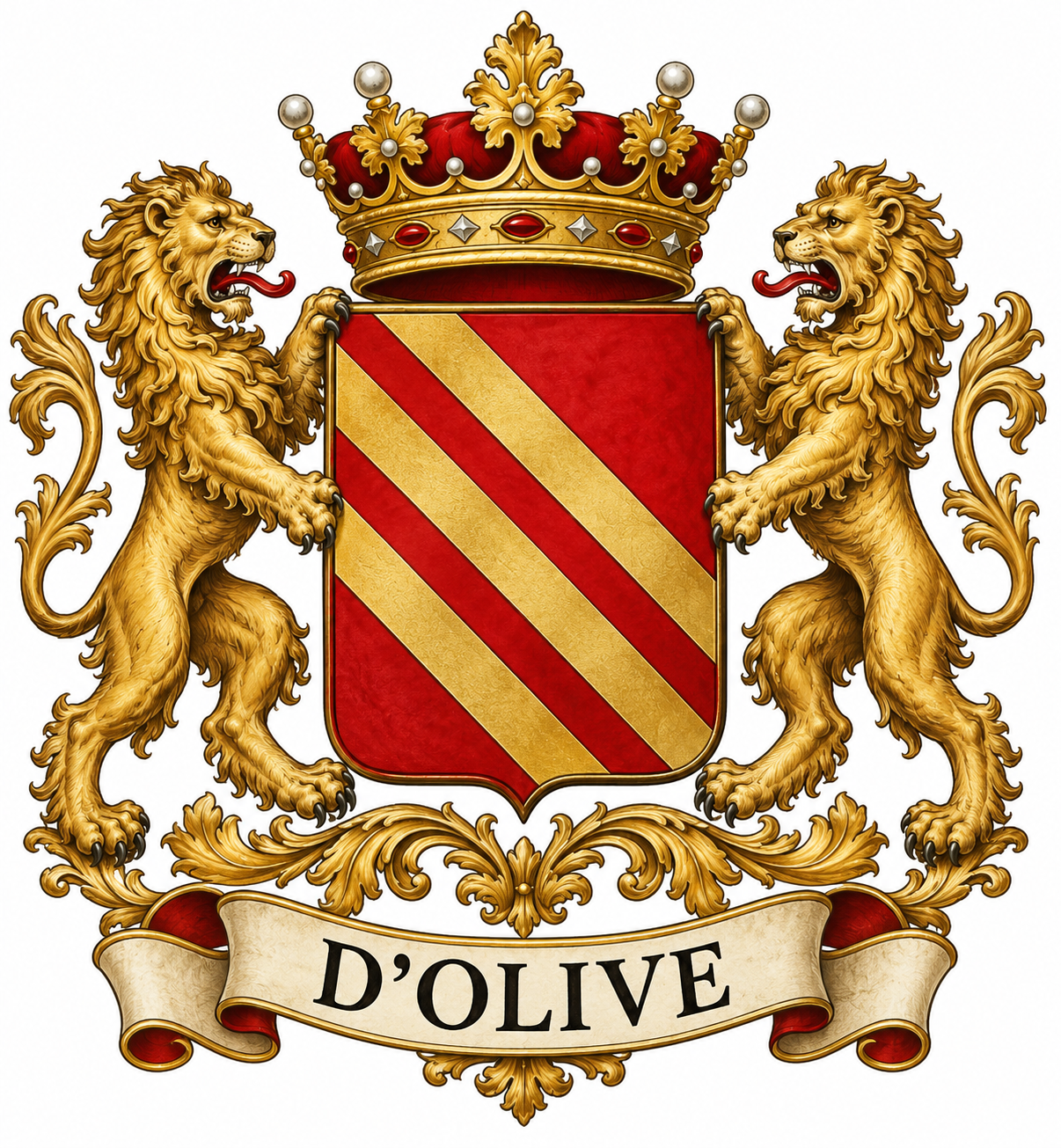
D'Olive Family Arms · Confirmed 1669–1670
The Blazon
De gueules, à trois bandes d'or. Couronne de marquis. Supports: deux lions.
Gules, three bendlets Or. Marquis's crown. Supporters: two lions.
The shield is red (gules), charged with three diagonal bands of gold (or). Above the shield rests a marquis's crown — a coronet of alternating pearls and points — signifying noble rank. The shield is flanked on either side by a lion rampant, the traditional supporters of a family of standing and consequence.
Reading the Arms
Gules (Red Field)
Shield
Courage, strength, and military valor. Red was the field color of warriors and magistrates of distinction throughout medieval France.
Three Bendlets Or
Gold Bands
Three diagonal bands of gold crossing the shield from upper-left to lower-right. Gold (or) in heraldry signifies generosity, elevation of mind, and wisdom.
Couronne de Marquis
Marquis Crown
The coronet of a marquis — ranking above a count and below a duke in the French peerage. Its alternating pearls and points are a precise heraldic indicator of rank.
Deux Lions
Lion Supporters
Two lions flanking the shield as supporters — a mark of a family of sufficient standing to bear full armorial achievement. Lions represent bravery, nobility, and royal favor.
Provenance & Authentication
The D'Olive coat of arms was found among the papers of Elsie D'Olive, grandmother of the family's American branch. The arms are those of the French magistrate family of Olive, Oliva, or Olivier — a family of Languedoc whose heraldic identity was formally confirmed by sovereign authority in the late seventeenth century.
The arms are believed to trace back to William III of Olive, Oliva, or Olivier, Bishop — a figure of ecclesiastical and civic standing in the Languedoc region. The episcopal connection explains the arms' formal confirmation through the sovereign judgment process, which was the mechanism by which noble and distinguished families registered their heraldic identity with the French crown.
September 23, 1669
First sovereign judgment confirming the arms of the family of Olive/Olivier in Languedoc.
January 10, 1670
Second sovereign judgment, reinforcing and formalizing the heraldic record of the family.
Archive Note
The arms were preserved in the papers of Elsie D'Olive and are now part of the D'Olive Family Heritage archive. The baptismal instrument of Dominique D'Olive (Archive E696, Tillac) corroborates the family's French origins and noble lineage.

Languedoc · Southern France
From Languedoc to Louisiana
The Languedoc region of southern France was home to a distinct legal and cultural tradition — the pays de droit écrit, where Roman law persisted long after it had faded elsewhere in France. Families of the magistrate class, like the Olive family, occupied a crucial position in this world: educated, propertied, and formally recognized by the crown.
Dominique D'Olive, baptized in Tillac, Gers, on June 6, 1741, carried this heritage across the Atlantic. His father Jean d'Olive and mother Marie Savabos were part of a family whose arms had been confirmed less than a century before Dominique's birth. When Dominique arrived in the Mobile Bay area around 1770–1771 and received his Spanish land grant in 1787, he brought with him not just his name but the full weight of a documented noble lineage.
The coat of arms is thus more than a decorative emblem. It is a document — a visual record of a family's standing, confirmed by sovereign authority, carried across an ocean, and preserved through six generations to the present day.
From Bishop to Baldwin County
William III of Olive
The arms are believed to originate with William III of Olive, Oliva, or Olivier, Bishop — a figure of ecclesiastical standing in Languedoc whose family held the gules-and-gold arms as their heraldic identity.
First Sovereign Judgment
On September 23, 1669, the first sovereign judgment formally confirms the arms of the family of Olive/Olivier in Languedoc, establishing the heraldic record with the French crown.
Second Sovereign Judgment
On January 10, 1670, a second sovereign judgment reinforces the family's heraldic registration, cementing the coat of arms as the confirmed mark of the D'Olive lineage.
Dominique Born in Tillac
Dominique D'Olive is baptized on June 6, 1741, in Tillac, Gers, France — heir to a family whose arms had been confirmed by royal authority less than a century before his birth.
Arms Cross the Atlantic
Dominique receives his Spanish land grant on the Eastern Shore of Mobile Bay. The D'Olive name — and the arms it carries — takes root permanently in American soil.
Preserved in the Family Archive
The coat of arms survives in the papers of Elsie D'Olive, grandmother of the American branch, and is now part of the D'Olive Family Heritage archive — a living connection to a lineage confirmed by kings.