

Dominique Crosses the Atlantic
From the hills of Gascony to the shores of Mobile Bay — the founding journey of the D'Olive family in America.
1741 – 1803
Dominique D'Olive
1741 – 1803 · Tillac, France → Mobile Bay, Alabama
"He crossed an ocean, helped found a city, and planted a name that would endure for centuries."
Dominique D'Olive was born on June 6, 1741, in the village of Tillac, Gers, in the Gascony region of southern France. His baptism is recorded in the authentic baptismal instrument preserved at Archive E696, Tillac — naming his godfather as Dominique Arquieu and his godmother as Marie d'Olive. His father, Jean d'Olive, was 27 years old; his mother, Marie Savabos, was 25.
A Captain Under Bienville
Dominique served as a captain in the army of Sieur de Bienville — the French colonial governor who founded the city of New Orleans. Under Bienville's command, Dominique participated directly in the foundation of the city of Mobile, a contribution that is formally recognized in historical records. His military service placed him at the center of French colonial expansion along the Gulf Coast at one of its most consequential moments.


Arrival on Mobile Bay
Around 1770–1771, Dominique arrived in the Mobile Bay area, then under British rule. He settled on Mon Louis Island with the family of his future wife, Marie-Louise Baudin. On May 23, 1772, he married Marie Louise Baudin in Mobile, Orleans Territory. Together they raised at least 9 children — 5 sons and 4 daughters — including Louis, Sefroy, Modeste, Genevieve Dominique, and Martha Euphrosine D'Olive.
The Spanish Land Grant of 1787
In 1787, Dominique received a Spanish land grant on the Eastern Shore of Mobile Bay — the foundation of what would become the D'Olive estate near present-day Daphne, Alabama. He had navigated the shifting empires of the Gulf Coast with remarkable adaptability: French origins, British Mobile, Spanish governance after 1780, and finally the emerging United States. The land grant was the physical anchor of the family's American legacy.
Death & Burial
Dominique D'Olive died on December 2, 1803, in Mobile. He was buried at the campo santo of that city, upon which the Cathedral of the Immaculate Conception was later erected. His remains were subsequently transferred to the Church Street Graveyard — the resting place of founders and important figures of Mobile, including Joe Cain and Julian Lee Rayford, celebrated figures of Shrove Tuesday tradition.
Village Point & The Land Grant
The land Dominique received in 1787 sits within what is now known as Village Point — a stretch of the Eastern Shore whose history stretches back to the earliest days of French colonial settlement.
Old Mobile established near St. Stephen's. French colonists farm both sides of the bay. The outpost that will become Daphne begins to take shape.
About 17 plantations, 124 people, and over 2,000 head of cattle in and around The Village — the community Dominique will soon join.
Dominique D'Olive arrives in Mobile Bay from France, settling on Mon Louis Island at the home of his future father-in-law. He farms and raises cattle.
Spain takes Mobile from the British. Dominique adapts to the new colonial authority.
Dominique receives the Spanish land grant for the Eastern Shore property. He continues to live in Mobile, with an overseer managing the farm and cattle.
Dominique dies at age 64. His son Louis takes over the plantation, builds the La Belle Rose Hotel on Mobile Bay, and accumulates roughly 1,200 acres.
Fort Mims Massacre and the Creek Indian War. The D'Olive plantation is attacked; the overseer and three slaves are forcibly taken to Pensacola. Louis moves his family to the plantation during this dangerous period.
Alabama becomes a state. Louis D'Olive and his uncle Turner Starke supply most of the bricks for Fort Morgan, shipped from Starke's Wharf.
Jackson's Oak
The historic Village Point Park Preserve is home to one of the largest and most storied live oaks in Alabama — over 95 feet tall with a circumference exceeding 28 feet. This tree was already a landmark in the eighteenth century, shown as a survey line marker in the original Spanish Land Grant survey map of 1787 — the very grant that gave Dominique D'Olive his Eastern Shore property. According to local tradition, General Andrew Jackson made a speech to his troops from one of its massive limbs while en route from Pensacola during the War of 1812.
"Shown as a survey line marker in the original 1787 Spanish Land Grant map — the same grant that established the D'Olive estate."
The D'Olive Cemetery
Village Point, Daphne, Alabama
The D'Olive Cemetery at Village Point dates to the early 1800s, making the D'Olive family the oldest recorded family in Daphne and one of the oldest in Baldwin County. Several graves remain with headstone inscriptions in French — a testament to the family's Gascon origins. The cemetery spans roughly one acre; the family section was originally enclosed by a wrought iron fence with a gate bearing the family name. Both the fence and gate were later vandalized and stolen. It is unknown how many people are buried here, as many graves are unmarked. An inscription on one stone reads: 'IN MEMORY OF LOUIS D'OLIVE, Born 1769 Died 1841 and his wife LOUISA LE FLEAU, Born 1782 Died 1841. Both natives of Alabama this stone is erected as a token of filial Love.' It was customary for early settlers to bury on their own plantation — these silent markers are often all that remains to tell the story of the pioneers.
IN MEMORY OF LOUIS D'OLIVE, Born 1769 Died 1841 and his wife LOUISA LE FLEAU, Born 1782 Died 1841. Both natives of Alabama this stone is erected as a token of filial Love.
Heraldry
The D'Olive Coat of Arms
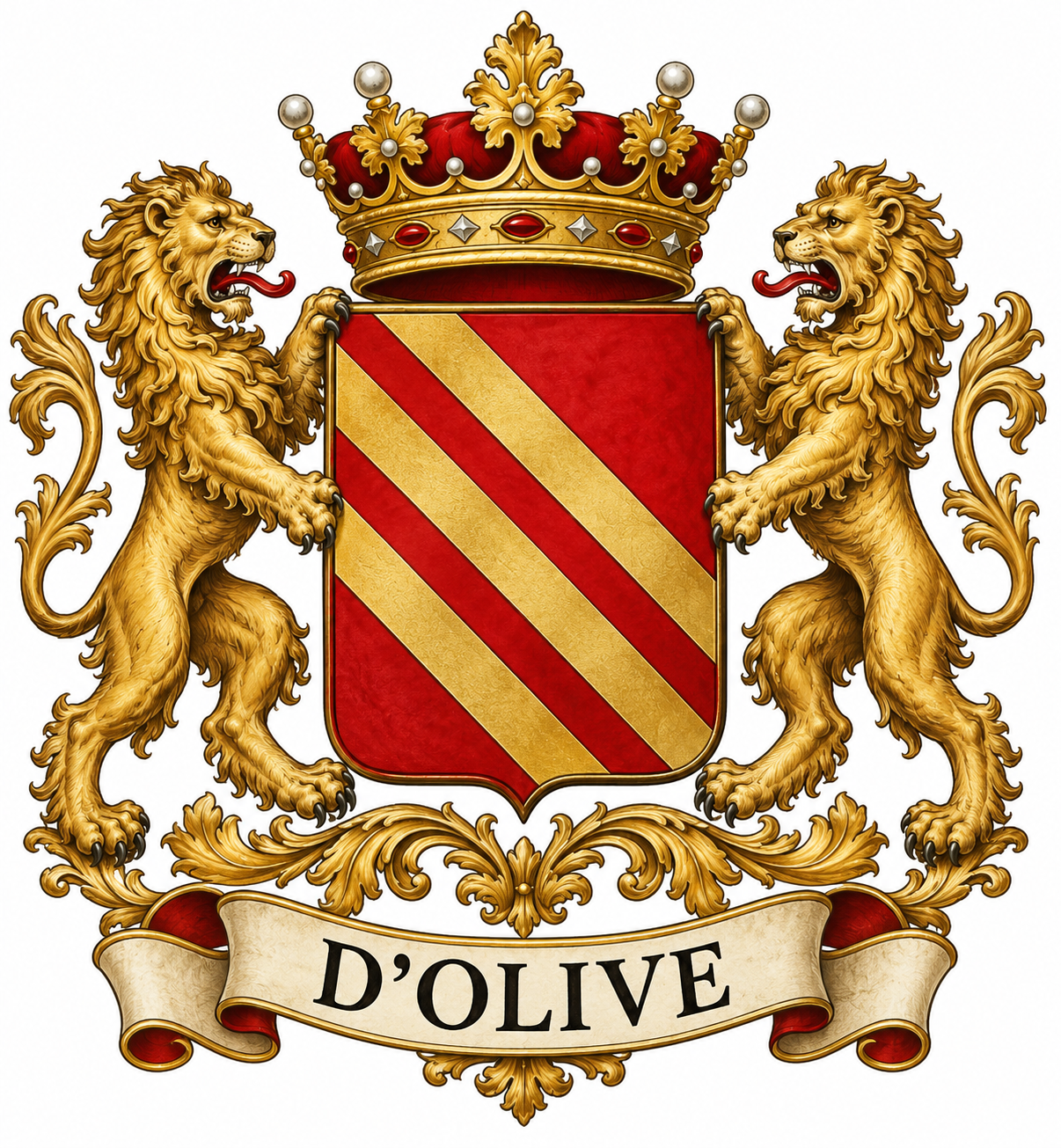
Among the papers of his grandmother Elsie d'Olive was a coat of arms of the family of French magistrates of Olive: gules with 3 gold bands. This heraldic device is believed to date back to William III of Olive, Oliva, or Olivier — a bishop — and speaks to the family's deep roots among the magistrate class of southern France.
Official Blazon
Gules with 3 gold bands
Crown of a Marquis. Supporters: two lions.
"An old family from Languedoc, maintained in its nobility by sovereign judgments rendered by Mr. Bazin de Besons, intendant of Languedoc, September 23, 1669 and January 10, 1670."
Marie Louise Baudin & Their Children
Married: May 23, 1772 — Mobile, Orleans Territory