

Gascony, France · c. 1300 – 1785
The D'Olive Family in France
Before Mobile Bay, before the Spanish land grant, before the American republic — the D'Olive family were Gascons, rooted in the rolling hills and bastide villages of southwestern France for at least four centuries.
A Gascon Family
The département of Gers in the heart of Gascony is a land of gentle hills, ancient villages, and deep family roots. It is the country of Armagnac brandy and foie gras, of the Pyrenees visible on clear days to the south, of bastide towns laid out in careful grids by medieval lords who wanted to populate their territories and collect their taxes. It is also, according to the family's own genealogical tradition, the country of the D'Olive family.
The earliest documented D'Olive in the family's records is placed in the Gers region in the fourteenth century — a period when the bastide towns of Gascony were being founded and the region's noble families were establishing the heraldic identities that would be confirmed and codified in the great heraldic surveys of the seventeenth century. The D'Olive coat of arms — confirmed by the sovereign judgments of 1669 and 1670 — speaks to a family with a long enough history to have developed and defended a heraldic identity across multiple generations.
The village of Tillac, in the commune of the same name in the Gers, is the specific place most closely associated with the D'Olive family's French origins. It is here that the baptismal record of Dominique D'Olive — born 1741, the man who would eventually receive the Spanish land grant on Mobile Bay — is preserved in the Archives Départementales du Gers as Archive E696. Tillac is a small bastide village, founded in the thirteenth century, perched on a ridge above the surrounding countryside. It is, in every sense, the beginning of the D'Olive story in America.

Gers · Gascony · Southwestern France
Gascony and the Gascon Character
Gascony has always been a distinct region within France — linguistically, culturally, and temperamentally. The Gascons spoke Occitan, not French; they were known throughout France for their pride, their independence, and their willingness to seek their fortunes far from home. The most famous Gascon in French literature is d'Artagnan, the musketeer from Lupiac in the Gers — a fictional character, but one who embodied real Gascon traits: courage, ambition, loyalty, and a certain reckless willingness to leave home and make something of oneself in the wider world.
The D'Olive family's eventual emigration to the French colonies — and Dominique's subsequent service under the Spanish crown in Louisiana and West Florida — fits a recognizable Gascon pattern. Gascony was a region that exported people: soldiers, merchants, administrators, colonists. The French colonial enterprise in North America drew heavily on men from the southwest of France, and the D'Olive family's presence in the Mobile Bay region is part of that larger story of Gascon mobility and ambition.
Gascony at a Glance
Region
Gascony (Gascogne), southwestern France
Département
Gers (32), created 1790 from historic Gascony
Language
Gascon Occitan (alongside French)
Village
Tillac, commune in the Gers, founded c. 1300
Archive
Archives Départementales du Gers, Auch
Key record
Baptismal register E696 — Dominique D'Olive, 1741

Armorial Général · Louis XIV · 1669–1670
The D'Olive Arms in France
The D'Olive coat of arms — azure, a chevron or between three olive branches vert, fructed or — was confirmed by the sovereign judgments of 1669 and 1670, during the great heraldic survey of France ordered by Louis XIV's minister Colbert. This survey, known as the Armorial Général, required all families claiming noble status to register and pay for their arms. The D'Olive family's arms were confirmed in this process, establishing their heraldic identity in the official record of the French crown.
The arms are directly descriptive of the family name: the olive branches (branches d'olivier in French) are a visual pun on 'D'Olive' — a common practice in medieval and early modern heraldry known as canting arms. The azure field and gold chevron speak to a family of some standing in the regional nobility of Gascony. The arms survived the Atlantic crossing: Elsie D'Olive's genealogical papers, compiled in the twentieth century, include copies of the French heraldic documents, and the arms are displayed on the family's coat of arms page.
The heraldic tradition also provides a clue to the family's social position in France. The confirmation of arms in 1669–1670 was not available to everyone — it required a claim to noble status and the means to pay the registration fee. The D'Olive family's successful registration suggests a family of at least minor noble standing in the Gascon regional hierarchy, consistent with the family's long tenure in the Tillac area and their eventual ability to produce a son — Dominique — who could navigate the colonial bureaucracies of both France and Spain.
The Letters of Joseph-Denis d'Olive
In May 1775 — just years before Dominique D'Olive would leave for the New World — his kinsman Joseph-Denis d'Olive, President of the Chamber of Petitions of the Parlement of Toulouse, wrote two remarkable letters from Paris to his brother Bernard-Denis. They survive today in the Archives Départementales de Haute-Garonne (ADHG – 1J720) and offer an unfiltered window into the d'Olive family at the height of their power.
Who Was Joseph-Denis d'Olive?
Joseph-Denis d'Olive (1724–1783) was the heir of one of Toulouse's great noble houses. His ancestry included a capitoul (city magistrate) in 1466, a syndic-general of the Province of Languedoc in 1610, and a father who served as royal counselor and substitute procurator-general in the Parlement of Toulouse. Joseph-Denis himself rose to president of the Chamber of Petitions — one of the most senior judicial offices in southern France.
He is also the man who retained and organized the bulk of the D'Olive family archive — the same papers now held at Princeton University Library in the John Hinsdale Scheide Collection (Boxes 180–194), comprising 1,805 catalogued records spanning 1353 to the early 19th century.
Key Facts
Born
1724, Toulouse
Died
1783
Title
President, Chamber of Petitions, Parlement of Toulouse
Brother
Bernard-Denis d’Olive, Canon at Saint-Sernin Abbey, Toulouse
Estate
Odars, near Toulouse
Archive
ADHG – 1J720 (letters); Princeton C0704 (family papers)
What the Letters Reveal
2 May 1775
Land Acquisition Near Montauban
Writing from Paris, Joseph-Denis describes a complex land deal: the purchase of the seigneurie of Labarthe — two leagues from Montauban, with high, middle, and low justice, three dependent parishes, 350 setiers of wheat in censive, and 2,300 arpents of arable land. The price was to be drawn from his wife Christine-Hélène Destancheau’s inheritance and the sale of other properties. He instructs his brother to keep the matter “the greatest secret” so that a rival buyer cannot interfere.
Estate Management
Managing the Odars Estate
Joseph-Denis entrusts Bernard-Denis with full management of the family’s estate at Odars — directing the tenant farmer Germier to deliver accounts, produce, vegetables, and fruit “as he would bring them to me if I were in Toulouse.” He instructs his brother to collect rents, pay creditors, and manage a loan of 1,400 livres. The letters reveal a sophisticated rural economy of wheat, wine, hay, poultry, and artichokes.
Family Life
Children’s Education at Sorèze
Joseph-Denis’s eldest son was enrolled at the École Royale Militaire de Sorèze — one of the most prestigious military academies in France. He writes: “Their education is what matters most to me.” He asks Bernard-Denis to escort the boy to Sorèze and coordinate with Dom Despaux, the school’s director. The letter closes with a message from Madame d’Olive herself, written in a different hand — warm, affectionate, and clearly at ease with her brother-in-law.
Sibling Network
A Family Bound by Solidarity
The letters paint a portrait of a noble family operating as a tightly coordinated network. Produce from the estate is distributed to sisters and their children. Legal victories in Paris are framed as “a fortune for our children” — the “our” meaning the entire extended family. Bernard-Denis, as a canon of the secular clergy, serves as the family’s indispensable agent in Toulouse: mediator, estate manager, guardian of the children, and trusted confidant.
The French Lineage — Simon to Dominique
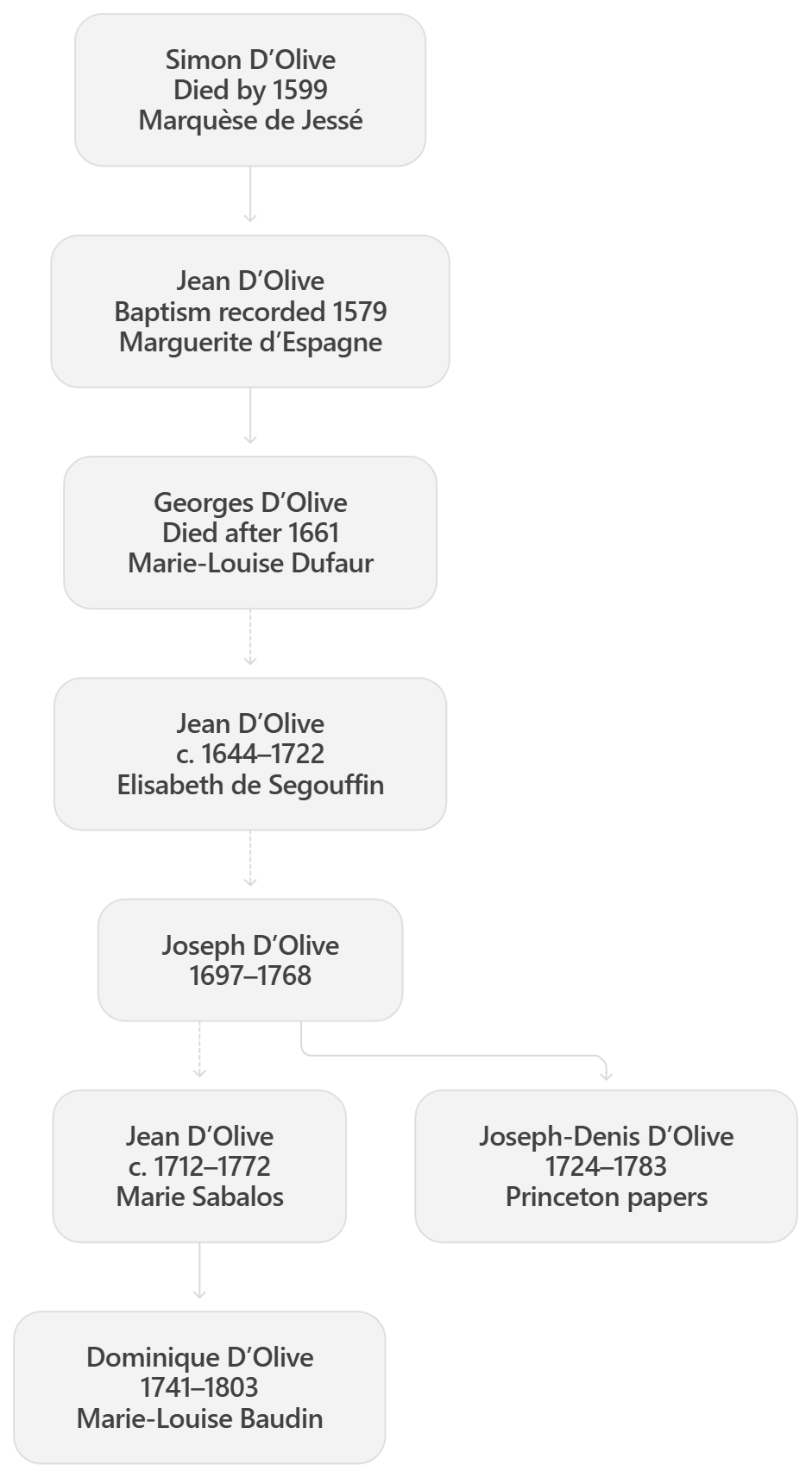
Six generations from Simon D'Olive (d. by 1599) to Dominique D'Olive (1741–1803), showing the branch that produced Joseph-Denis d'Olive (1724–1783) and the line that emigrated to the Gulf Coast.
“Je suis avec l'amitié la plus tendre votre frère D'Olive.”
“I am with the most tender friendship your brother D'Olive.”
— Joseph-Denis d'Olive, Paris, 2 May 1775
Archival Source
These letters were transcribed and published by historian Damien Lagarde as part of the Correspondances Adelphiques research project, which studies sibling correspondence in early modern France. The originals are held at the Archives Départementales de Haute-Garonne, Toulouse (ADHG – 1J720).
Read the full transcription (French) →Dominique D'Olive: From Tillac to Mobile Bay
Dominique D'Olive was born in Tillac in 1741, the son of a Gascon family with roots in the village going back at least several generations. The baptismal record preserved in Archive E696 at the Archives Départementales du Gers is the earliest documentary evidence of his existence — a few lines of Latin in a parish register, recording the name of a child who would eventually become the founder of an American family.
The circumstances of Dominique's emigration from France are not fully documented. He appears in the records of French Louisiana and later Spanish West Florida as an adult, suggesting he emigrated sometime in the 1760s or 1770s — a period when the transfer of Louisiana from France to Spain (1762) was reshaping the colonial landscape of the Gulf Coast. Many French colonists in Louisiana and West Florida remained in place under Spanish rule; others, like Dominique, may have emigrated specifically to seek opportunities in the Spanish colonial system.
By 1787, Dominique D'Olive was established enough in the Mobile Bay region to receive a Spanish land grant of approximately 640 acres on the Eastern Shore — the grant that would eventually give his name to D'Olive Creek, D'Olive Bay, and D'Olive Road. The journey from a baptismal font in a Gascon village to a land grant on the Gulf Coast of North America is the central arc of the D'Olive family story, and it begins in Tillac.
From Gascony to the Gulf Coast
c. 1300
D'Olive Family in Gascony
The earliest D'Olive family presence in the Gers region of Gascony, according to the family's genealogical tradition. The bastide towns of Gascony are being founded during this period; Tillac is established as a bastide village on a ridge in the Gers.
1669–1670
Coat of Arms Confirmed
The sovereign judgments of 1669 and 1670 confirm the D'Olive coat of arms — azure, a chevron or between three olive branches vert, fructed or — in the Armorial Général of Louis XIV. The confirmation establishes the family's heraldic identity in the official record of the French crown.
1741
Dominique D'Olive Born in Tillac
Dominique D'Olive is born in the village of Tillac, Gers, France. His baptismal record is preserved in the Archives Départementales du Gers as Archive E696 — the earliest documentary evidence of the man who will found the American branch of the D'Olive family.
c. 1760s–1770s
Emigration to the New World
Dominique D'Olive emigrates from France to the Gulf Coast of North America, likely during the period of transition from French to Spanish colonial rule in Louisiana and West Florida. The exact circumstances of his emigration are not fully documented.
1780
Spanish Colonial Service
Dominique D'Olive is documented in the Mobile Bay region during the Spanish colonial period. Governor Bernardo de Gálvez's campaigns against the British in West Florida (1779–1781) are reshaping the colonial landscape of the Gulf Coast.
1787
The Land Grant
Governor Esteban Miró grants Dominique D'Olive approximately 640 acres on the Eastern Shore of Mobile Bay. The grant establishes the D'Olive family's permanent presence on the land that will bear their name — D'Olive Creek, D'Olive Bay, D'Olive Road — for more than two centuries.
Elsie D'Olive and the French Connection
The link between the American D'Olive family and their French Gascon origins was preserved largely through the work of Elsie D'Olive, who compiled the family's genealogical papers in the twentieth century. Elsie's papers include copies of the French heraldic documents confirming the D'Olive coat of arms, references to the Tillac baptismal record, and the family tradition connecting the American D'Olives to the Gascon village. Without Elsie's work, the French origins of the family might have been lost entirely — another American family whose European roots faded into the general anonymity of the immigrant past.
"The name D'Olive is French — it means 'of the olive' — and the olive branches on the coat of arms are not decoration. They are the family's identity, carried from Gascony to the Gulf Coast and preserved across three centuries."
— Family tradition, preserved in the Elsie D'Olive Papers
Researching the French Origins
Auch, France
Archives Départementales du Gers
The primary archive for Tillac parish records. Archive E696 contains the 1741 baptismal record of Dominique D'Olive. Earlier D'Olive family records may exist in the same collection.
Bibliothèque nationale de France, Paris
Armorial Général de France
The national heraldic register compiled under Louis XIV. The D'Olive coat of arms confirmation of 1669–1670 is documented here. Available in part through Gallica, the BnF digital library.
Paris / Pierrefitte-sur-Seine
Archives Nationales de France
National archives holding notarial records, royal grants, and administrative documents from the Ancien Régime. May contain D'Olive family records predating the parish registers.
Online (familysearch.org)
FamilySearch France Collections
FamilySearch has digitized significant portions of French departmental archives, including Gers parish registers. A useful starting point for online research before visiting Auch in person.